




What Happened
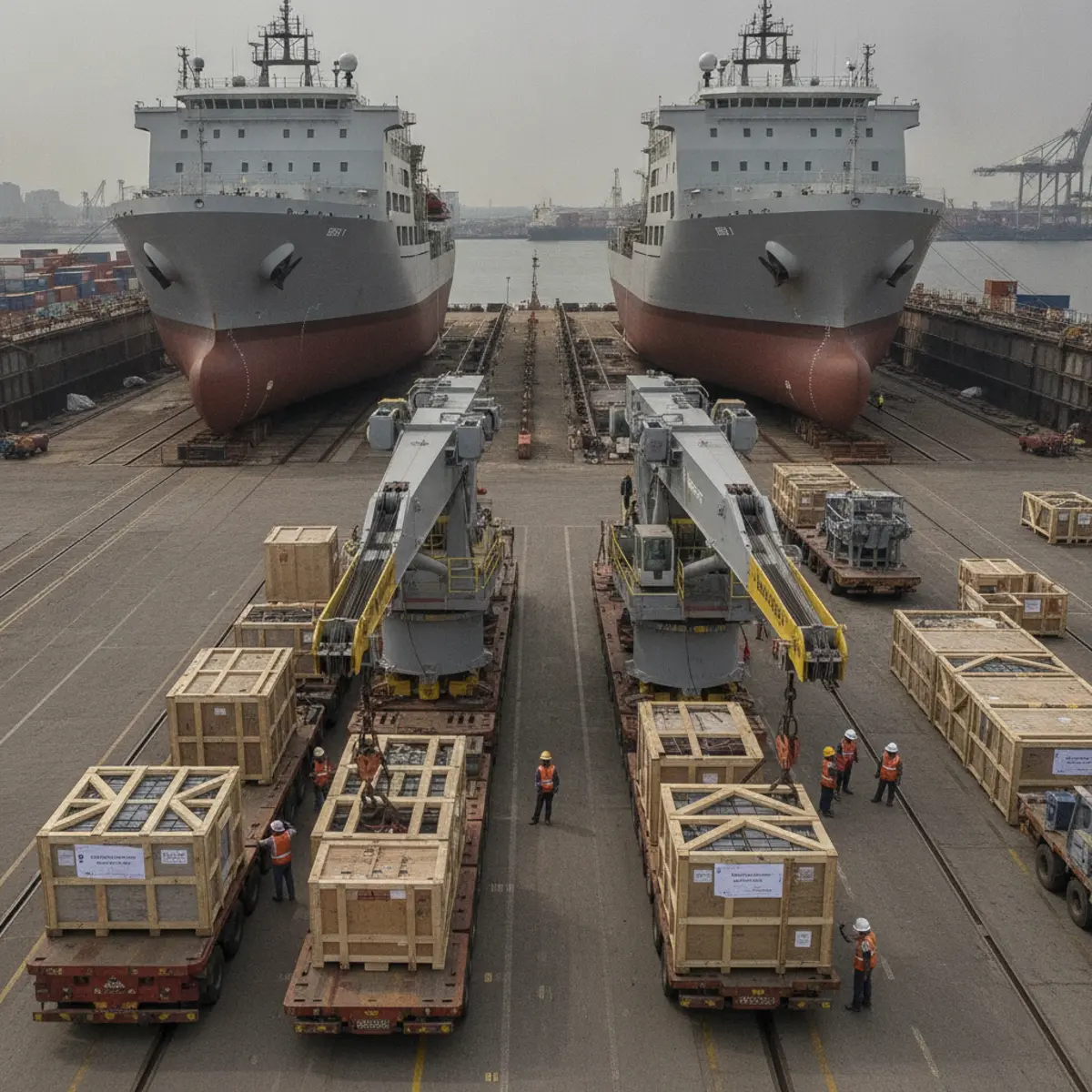
MacGregor has won orders to supply deck cranes, handling equipment and deck machinery for 4 new oceanographic research vessels, Container News reported on 14 September 2026. Yards in Spain will build 2 of the ships for Germany’s Federal Maritime and Hydrographic Agency, the BSH. Yards in India will build the other 2 for the Geological Survey of India, the GSI. Container News did not publish contract values, yard names or delivery dates. The award covers equipment supply rather than hull construction, and every vessel in the programme is a new build rather than a conversion.
What a Research Vessel Order Signals for Project Cargo Flows
For UK exporters and importers, the immediate relevance sits in project and out-of-gauge cargo rather than in containers. Deck cranes, winches and handling machinery move as break bulk or on flat racks, and their components travel from suppliers across Europe and Asia into the receiving yards. Any UK firm feeding that build chain, whether castings, hydraulics, electrical panels or control systems, will be quoting against fixed yard milestones. That makes confirmed sailing dates and agreed lifting arrangements more important than the headline rate on any single booking.
The award also sits inside a pattern of state-funded survey tonnage being ordered across parallel yards rather than placed with one builder. Splitting 4 hulls between Spain and India spreads schedule risk for the buyers, but it multiplies the number of inbound supply lanes a component maker has to serve. That matters for cargo routed to Indian yards, where ocean freight services from UK ports commonly run via transhipment hubs rather than direct calls, and where destination clearance falls to whichever party the agreed Incoterms 2020 term names.
Suppliers with a stake in either programme should pin down 3 points early. First, the Incoterms 2020 term on every purchase order, because a delivered term into a Spanish or Indian yard puts the import entry and local charges on the seller. Second, the export control position of survey and hydrographic equipment, which can carry licensing obligations depending on specification and destination. Third, the lifting and securing plan for each out-of-gauge piece, because a crane pedestal booked late misses the sailing rather than the yard slot.
Key Takeaway
Equipment awards of this kind are a forward indicator of project cargo demand, not container demand. UK suppliers feeding the 4 hulls should treat yard milestones as the binding constraint and confirm the Incoterms 2020 term before the first component leaves the works, since the term decides who clears and who pays at destination.
Market Impact
Research and survey newbuilds are a small part of the global orderbook, so this award will not move container rates or vessel availability on mainstream trades. Its effect is narrower and more practical: a steady pull on break bulk and flat rack capacity into 2 yard regions, plus air freight demand for late or replacement items. Break bulk space out of northern Europe is booked further ahead than container space, and a single missed loading pushes a component to the next available sailing.
The wider read for UK businesses is that hydrographic and survey capacity is being renewed by public agencies in Europe and Asia at the same time. That sustains demand for specialist marine equipment, instrumentation and calibration work, much of which moves as high-value, time-critical air freight rather than by sea. Where goods leave the UK for fitting and later return for repair or calibration, inward and outward processing relief prevents duty being paid twice on the same vessel component.
Reported by the Plexus Freight team, from Container News.
Source: https://container-news.com/macgregor-wins-equipment-orders-for-four-research-vessels/