

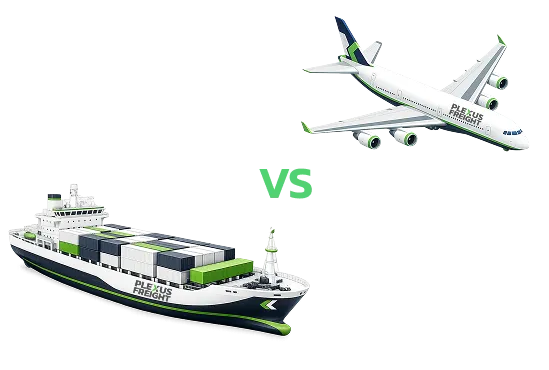



This free guide from our Portishead team explains how to compare air freight cost against sea freight cost for your specific consignment, with a worked example showing where the breakeven point usually falls. No sign up required. For a confirmed all in quote on both modes, contact our team. We respond within 1 working hour.
Air Freight vs Sea Freight. The Core Difference.
Air freight and sea freight are priced on completely different bases, which is why a direct cost comparison needs a few extra steps rather than a single number.
Air freight is priced on chargeable weight, the greater of your actual gross weight and your volumetric weight, with the rate applied per kilogram. Sea freight is priced per container for full container loads, or per cubic metre or per tonne for less than container loads. This means air freight cost scales with weight and volume together, while sea freight cost is largely fixed once you have booked a container, regardless of how full it is.
How to Compare Air Freight and Sea Freight Cost.
Step 1: Work Out Your Chargeable Weight for Air Freight
Calculate your volumetric weight by multiplying length, width and height in centimetres and dividing by 6000. Compare this to your actual gross weight. The higher figure is your chargeable weight, and this is what the airline charges you for.
Step 2: Apply the Air Freight Rate per Kilogram
Multiply your chargeable weight by the current air freight rate per kilogram for your route, then add fuel surcharge, security surcharge and airport handling fees at both ends.
Step 3: Work Out Your Sea Freight Cost
For a full container load, this is a flat rate per container regardless of how full it is. For a less than container load, multiply your cargo volume in cubic metres, or weight in tonnes, by the applicable per unit rate, then add port and handling surcharges.
Step 4: Compare the Total Landed Cost, Not Just the Freight Rate
Add customs documentation coordination costs, which apply to both modes, then compare the 2 totals against your required delivery deadline.
Worked Example.
Here is a simplified example using a 300 kg consignment with a volume of 1.5 cubic metres, moving from China to the UK.
| Factor | Air Freight | Sea Freight (LCL) |
| Chargeable basis | 300 kg (actual weight governs) | 1.5 cubic metres |
| Typical transit time | 3 to 5 working days | 30 to 38 days door to door |
| Cost per unit | Higher per kg | Lower per cubic metre |
| Best suited to | Urgent, time critical orders | Planned, non urgent orders |
For small consignments under 500 kg with a flexible delivery window, sea freight is almost always significantly cheaper per kilogram. For the same consignment with an urgent deadline, air freight cost is usually justified by the speed.
This is an indicative example only. Actual rates vary with current market conditions, fuel prices and the specific lane.
When Air Freight Is the Right Choice.
Air freight tends to be the better choice when delivery is required within 7 working days, when your consignment is under 500 kg, when stock shortfalls or production deadlines apply, or when the commercial value of your goods makes the additional speed worth the higher cost per kilogram.
When Sea Freight Is the Right Choice.
Sea freight tends to be the better choice when your delivery window allows 25 days or more, when your consignment exceeds 500 kg, when cost per kilogram is the primary consideration, or when you are shipping a full container or a high volume less than container load.
Customs Cost Applies to Both Modes Equally.
A common mistake when comparing air and sea freight is assuming customs cost only applies to one mode. It does not. Every commercial import into the UK requires a CDS customs entry regardless of whether it arrives by air or by sea, and import duty and VAT are calculated the same way on both modes based on commodity code and customs value.
Our Portishead team coordinates customs documentation alongside every air and sea freight movement we arrange via our dedicated 3rd party agents, so this cost is already included in the comparison you receive at the quotation stage.
Contact our team for customs coordination
Frequently Asked Questions
For most consignments over 500 kg with a flexible delivery deadline, yes, sea freight is significantly cheaper per kilogram. For small, urgent or high value consignments under 500 kg where speed matters more than cost, air freight can be the more practical choice despite the higher rate per kilogram.
Air freight is priced on chargeable weight, the greater of actual gross weight and volumetric weight, calculated by multiplying length, width and height in centimetres and dividing by 6000. Fuel surcharge, security surcharge and airport handling fees are added on top.
Full container loads are priced per container, regardless of how full it is. Less than container loads are priced per cubic metre or per tonne, whichever is greater. Port and handling surcharges apply on top of the base freight rate.
There is no single fixed breakeven figure, since it depends on your specific cargo density, the current rate per kilogram for air and the rate per cubic metre for sea on your particular lane. As a general rule, lower weight, higher value, time critical cargo favours air, while higher weight, lower value, planned cargo favours sea.
No. Every commercial import into the UK requires a CDS customs entry regardless of the mode used, and import duty and VAT are calculated the same way based on commodity code and customs value, not on whether the goods arrived by air or by sea.